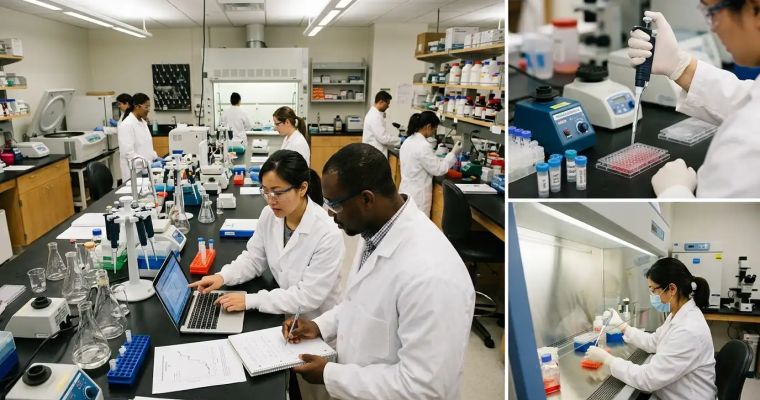
The Rise of AI Co-Pilots in Pharmaceutical Research
The AI drug discovery revolution arrived later than expected and works differently than advertised. The tools that are actually delivering value are less dramatic and more useful.

The pharmaceutical industry has a productivity problem that has been visible in the data for long enough that it has its own name. Eroom's Law, Moore's Law spelled backwards, describes the observation that the number of new drugs approved per billion dollars of R&D spending has roughly halved every nine years since the 1950s. Costs go up. Output per dollar goes down. The trend has persisted through multiple waves of technological optimism.
AI was supposed to break this trend. The claims made in 2018 and 2019 about AI-driven drug discovery were, in retrospect, significantly ahead of the evidence. Several high-profile AI drug discovery companies have had to revise their timelines considerably. The first AI-discovered drug to reach late-stage clinical trials arrived later than the most optimistic projections suggested, and the attrition rates in AI-originated pipelines have turned out to resemble those in conventionally discovered ones more than anyone would have predicted.
None of this means AI is not useful in pharmaceutical research. It means the useful applications are different from the ones that attracted the most attention, and, in several areas, more immediately practical.
Where AI is actually delivering value in pharma R&D
The clearest near-term value is not in de novo drug design but in literature intelligence and target identification. Pharmaceutical research teams are dealing with the same information overload problem as academic researchers, but at a different scale and with different stakes. A target that has been validated in the academic literature but has not yet appeared on a company's internal radar represents a genuine competitive opportunity, and a systematic gap in landscape analysis.
AI systems that can continuously monitor the published literature, patent filings, clinical trial registries, and conference proceedings, and surface emerging signals before they become widely known, are providing real value to teams doing early-stage pipeline planning. This is not speculative. It is a workflow improvement that is measurable in time and in the quality of the landscape analyses that inform portfolio decisions.
The second area of practical impact is in clinical trial design. Trial design is extraordinarily consequential, a poorly designed trial that fails for reasons unrelated to the drug's actual efficacy represents hundreds of millions of dollars and years of time lost. AI tools that can analyse the methodological characteristics of previous trials in the same indication, identify design features associated with success or failure, and surface evidence about patient population heterogeneity that affects endpoint sensitivity are being used by trial design teams at several major pharmaceutical companies. The results are hard to quantify from the outside, but the adoption rate suggests the internal evidence is compelling.
The co-pilot framing and why it matters
The language of "co-pilot" has become somewhat overused in technology marketing, but in the pharmaceutical research context it captures something important. The researchers and scientists doing this work are not being replaced by AI systems. They are being given AI systems that handle the information-processing load so that expert judgment can be applied to a cleaner, better-structured picture of the problem.
This distinction matters because the failure modes of the two models are very different. A system designed to replace expert judgment will fail in high-stakes situations in ways that are difficult to anticipate and expensive to correct. A system designed to augment expert judgment fails more gracefully, the expert is still present, still accountable, still applying domain knowledge that the system does not have. When the system is wrong, the expert catches it. When the system is right, it saves time and surfaces information that would otherwise have been missed.
At NousLab, this is the model we have built around, partly because we believe it is more appropriate to the regulatory and ethical requirements of medical research, and partly because it is what the researchers we work with actually want. They are not looking for a system that makes decisions. They are looking for a system that makes their own decision-making better informed.
Regulatory considerations and the question of explainability
Pharmaceutical research operates under regulatory frameworks that have not yet fully caught up with AI-assisted workflows. The FDA's guidance on AI and machine learning in drug development is evolving, and different jurisdictions are moving at different speeds. The general direction is toward requiring greater transparency and explainability in AI systems used in regulatory submissions, which has implications for how these tools are designed and validated.
This is one reason the black-box criticism of early AI drug discovery tools has had lasting impact. A company that uses an AI system to identify a drug candidate but cannot explain the reasoning chain behind that identification faces real challenges at the regulatory interface. The tools that are gaining adoption in serious pharmaceutical R&D environments are increasingly the ones that show their work, that provide traceable reasoning, cited sources, and uncertainty estimates rather than confident outputs without provenance.
The FDA's AI/ML drug development framework is worth reading for anyone building or evaluating tools in this space. It signals clearly that explainability and auditability are going to be requirements, not nice-to-haves, in regulated research contexts.
The realistic medium-term picture
Eroom's Law may yet be broken. The mechanisms that could break it, better target identification, faster and more predictive preclinical models, smarter trial design, earlier failure of compounds that are going to fail, are all areas where AI tools are demonstrably improving. But the timelines involved in drug development mean that the impact of current AI adoption will not be visible in approval statistics for another decade.
What is visible now is more modest and more real: research teams that are better informed, faster at synthesising evidence, and more systematic in their landscape analysis than they were five years ago. That is not the revolution that was promised. It is the improvement that was delivered. In pharmaceutical research, where the cost of a missed signal or a flawed assumption compounds over years and billions of dollars, that improvement is not trivial.
The co-pilots are here. They are useful. They are not flying the plane. See how pharmaceutical research teams are using NousLab in practice.